Academy at the Lakes senior earns national recognition, $2,000 grant for neurosurgery tool
LAND O’ LAKES — Darren Lau wears glasses. He needs them to see and is colorblind.
But he also invented another pair that could one day radically change the medical landscape.
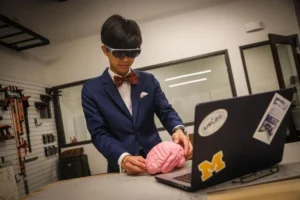
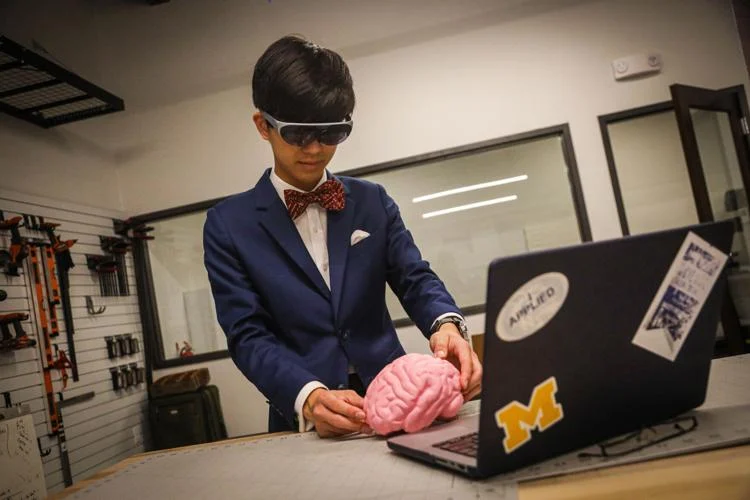
The Academy at the Lakes senior invented the Augmented Reality Intraoperative Neurosurgical System, or AuRING — a device using AI and AR technology to aid surgeons during brain surgery.
“I had a close friend who had a brain tumor,” Lau said. “When they underwent neurosurgery, they suffered complications from brain shift. Luckily, they were OK.
“After that health scare, I started researching potential solutions and saw there was a gap in what could be implemented in the operating room,” he continued. “I thought, well, I have some knowledge of AI and augmented reality. Maybe I can put that to use. And it’s very fitting because augmented reality is becoming more prevalent in the operating room.”
Brain shift occurs when, during surgery, the brain shifts, moves or compresses — literally moving from factors such as gravity or surgical instruments touching tissue.
That’s where AuRING (patent pending) comes in. Using an algorithm that factors in preoperative MRI and intraoperative ultrasound data, the AR glasses provide a virtual guideline over the neurosurgeon’s view, essentially mapping a route to the tumor. The device supports real-time surgical decision-making and helps surgeons maintain precise tumor localization throughout procedures.
“I want to be at the intersection of medicine and technology,” Lau said. “I hope to engineer devices that can help surgeons and doctors, but I also want to use technology to help people.
“I was inspired by a friend, and it’s amazing what inspiration can do.”
Lau’s work has already paid off.
He entered the device in the 2026 Regeneron Science Talent Search, a national stage for students to present original, independent research. AuRING was selected as one of 300 scholars from more than 2,600 applicants from 826 schools nationwide, earning both Lau and the Academy at the Lakes a $2,000 grant.
Lau said he’ll use the grant to continue developing the software and technology, even though AuRING stemmed from a different project related to his everyday glasses.
Rokid, a company specializing in AR glasses, donated a pair of Air AR glasses to Lau. As a freshman, he used them to develop a different algorithm — one to help colorblind people like himself see better.
That worked, too, with Lau using himself as a test subject.
“I was able to wear these glasses with my software and see colors more accurately and with more contrast,” he said. “When we tested it with participants, there was a 30% to 35% increase in accuracy in visualizing colors. I also turned it into a mobile app.”
That app won the Congressional App Challenge.
“When he was in eighth grade, he was already working with augmented reality and machine learning, well before it was mainstream,” said Colleen McCormick, middle school director and science chair, who mentored Lau for previous science fairs. “It’s incredible that he was ahead of his time.
“He’ll bring things to me, and I’m looking them up and learning his science,” she added. “The biggest thing for a successful science fair project is a good question, and he comes up with great questions. That’s what drives the inspiration and success of his project — asking great questions and his ability to wonder and be curious about the world around him.”